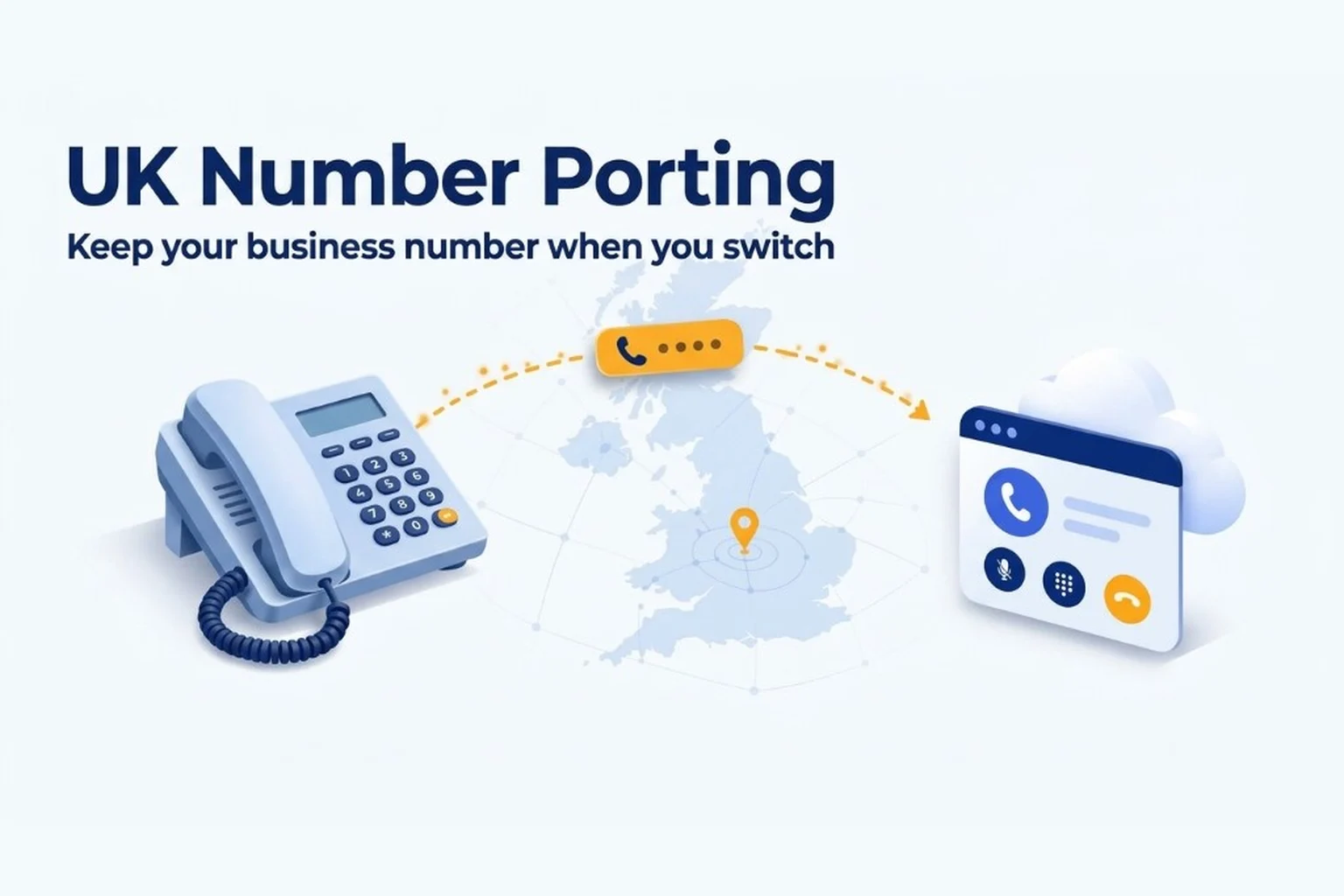
Imagine your business has used the same 0800 number for years. Customers recognise it, your website displays it, and your sales team relies on it daily. Then one day you realise your current phone system no longer meets your needs. You want a more flexible cloud phone setup — but you do not want to throw away the number everyone already knows.
That is where number porting comes in. In plain terms, it lets you transfer an eligible telephone number from one communications provider to another, subject to provider support and the rules that apply to that number.
In the UK, 0800 numbers are freephone numbers, so callers can contact your business without paying for the call from UK landlines and mobiles under the applicable arrangements. Your business may still pay incoming call charges under its service agreement — see are 0800 numbers free? and who pays for 0800 calls if you want the caller-side detail.
So how do you port a UK 0800 number without creating a mess? In this guide, I’ll walk you through how number porting works, which numbers may qualify, and what the transfer process looks like in practice. I’ll also cover potential costs, timelines, common challenges, and how to choose a provider — without inventing guarantees that depend on your exact number and account.
By the end, you should know how to plan a UK 0800 number port and reduce the risk of avoidable disruption. Let’s start with what number porting actually means for your business.
1. What is number porting and why does it matter for businesses?
Number porting lets a business transfer its existing telephone number from one communications provider to another. The practical benefit is simple: you can change your phone service without automatically changing the number your customers already know.
That flexibility matters when you are upgrading to cloud telephony or a modern contact centre. Instead of starting from scratch with a brand-new number, you can explore better features while keeping an eligible existing number — including an established freephone line.
1.1 How does number porting work?
The process usually involves three main parties:
- Losing provider: Your current telecom provider that supplies the existing number.
- Gaining provider: The new provider that receives your number and arranges the transfer.
- Telecom network: The infrastructure and routing systems that help direct calls to the correct destination.
Typically, you submit a porting request through your new provider. That provider then checks eligibility, validates your details, and coordinates the transfer with the relevant parties.
One important nuance: porting transfers the number, not necessarily your entire phone system. You may still need to configure call forwarding, IVR menus, voicemail, and other features separately on the new platform.
For example, imagine your customer service team still uses a traditional phone system. You want to move to a cloud PBX with remote access and call analytics. With a successful port, you can keep your advertised business number while moving the technology behind it.
1.2 Why is number porting important for businesses?
Your business phone number often shows up across many customer touchpoints. Changing it can create unnecessary work and confusion — website updates, brochures, ads, email signatures, supplier forms, the lot.
Business number porting can help you:
- Preserve customer recognition: Existing customers can keep using a familiar number.
- Avoid updating marketing materials: You may not need to replace the number on your website, brochures, and sales materials.
- Maintain customer access: You can plan the transition around your existing inbound communication needs.
- Upgrade your phone system: You can explore cloud PBX, call routing, and contact centre features without automatically changing your public-facing number.
That said, successful porting still depends on number eligibility and careful migration planning. It is not automatic for every number or every provider pairing.
1.3 Number porting vs getting a new business number
Which option makes more sense? It depends on your current number, migration requirements, and future communication plans.
| Factor | Number porting | New business number |
|---|---|---|
| Existing number | Retained if eligible | Replaced |
| Customer communication | Usually simpler | May require customer updates |
| Setup | Requires transfer checks | Requires new-number setup |
| Main risk | Rejection or transfer disruption | Customers may keep calling the old number |
Overall, number porting can help businesses preserve continuity while upgrading communications. In the UK, Ofcom’s number portability framework supports number retention when customers change providers, subject to the applicable rules. If you do not have a freephone number yet, you can also get a new UK 0800 number instead of porting.
Next, let’s look at UK 0800 numbers, how they work, and why businesses use them.
2. Understanding UK 0800 numbers and their business uses
UK 0800 numbers give businesses a practical way to handle customer enquiries across the country. Unlike geographic numbers, they do not tie a business’s public-facing number to a specific UK city. That makes them useful for national sales, customer service, and contact centre operations.
An 0800 number is more than “a way to receive calls”, though. When you connect it to the right phone system, it can help you manage enquiries and deliver more consistent support.
2.1 What is a UK 0800 freephone number?
A UK 0800 freephone number allows callers to contact a business without paying for the call from UK landlines and mobiles under the applicable arrangements. Instead, the receiving business typically pays for incoming calls according to its provider’s service plan.
To see where 0800 fits, it helps to compare common UK number types:
- 01 and 02 numbers: Geographic numbers associated with specific UK areas.
- 03 numbers: Non-geographic numbers charged at geographic-rate levels, with calls included in relevant bundled allowances.
- 0800 numbers: Freephone numbers that allow callers to contact businesses without paying for the call.
- 0808 numbers: Another UK freephone range used by businesses and organisations — see UK 0808 numbers.
Which option should you choose? It depends on your audience, budget, and communication goals. An 0800 number may suit a national customer support service, while a geographic number may better reflect a local business presence. For the broader buyer journey, see our UK phone number guide or the phone number hub (UK and 90+ countries).
2.2 Why do businesses use 0800 numbers?
Businesses across different industries use 0800 numbers to make customer communication easier. Common applications include:
- Customer support: Help customers resolve product issues and service queries.
- Sales and lead generation: Give prospective customers a dedicated number for enquiries.
- Financial services and insurance: Provide a contact point for policy questions and customer assistance.
- E-commerce: Handle order updates, delivery queries, refunds, and returns.
- Healthcare administration: Manage appointment enquiries and non-emergency administrative calls.
- National businesses: Support customers across multiple UK regions through centralised call handling.
You can also connect an 0800 number to a cloud PBX or contact centre. Depending on the provider, that can enable call queues, IVR menus, business-hour routing, and voicemail — see features and IVR & auto-attendant.
2.3 Can you port an existing UK 0800 number?
Yes — eligible UK 0800 numbers can generally be transferred to another supporting communications provider. I still recommend checking the exact number before you plan the migration.
The receiving provider should confirm number portability, range support, and any relevant restrictions. Number porting also does not automatically transfer ownership paperwork in the way people sometimes assume, and it does not recreate your existing phone system configuration.
For example, a UK retailer might replace an older call-handling platform with a cloud contact centre. By porting an eligible 0800 number, the retailer can keep its established customer-facing number while configuring new call queues and routing rules.
Certain number ranges or unusual account histories may need additional checks. Confirm eligibility with the receiving provider before you make contractual changes.
Keep your existing UK 0800 number
Check whether your existing UK 0800 number can move with you when you switch providers.
Check Freephone Porting Eligibility →Next, let’s walk through the number porting process step by step.
3. How to port a UK 0800 number: step-by-step process
If you want to transfer an existing UK 0800 number, careful planning makes the process easier. I recommend checking eligibility first, preparing your account details, and configuring your new phone system before the transfer date.
Here is how I would approach a UK 0800 number port, from the first checks through to post-transfer testing.
Step 1 — Check whether your 0800 number is eligible
First, contact your prospective communications provider and request a portability check. Share your complete 0800 number and identify your current provider.
Ask the provider to confirm:
- Whether your specific 0800 number can be transferred.
- Whether it supports the relevant number range.
- Whether associated services can continue after the transfer.
- Whether account, ownership, or contractual issues could delay the request.
Eligibility can vary by number range and provider. Get confirmation before you change your existing service.
Step 2 — Gather the required information
Once the provider confirms potential eligibility, prepare the information needed for the application. Accurate details help prevent avoidable delays.
The receiving provider may request:
- Your full 0800 number or list of numbers.
- The registered business or account-holder name.
- Your account reference and current provider details.
- The registered service or billing address, where applicable.
- A recent bill or letter of authority.
- Additional documents for complex accounts or number ranges.
Requirements vary by provider and number type. Ask for the exact document checklist before you submit.
Step 3 — Submit the porting request
After gathering the documents, submit your application to the receiving provider. This gaining provider typically coordinates the transfer with your existing provider.
During validation, the providers may check your number details and account information. Even small discrepancies can lead to rejection or delay. An outdated business name or incorrect account reference may stop the application from matching existing records. Double-check every field and make sure your number list is complete before submission.
Step 4 — Prepare the new phone system
While the providers coordinate the transfer, configure your new phone system. That preparation helps you direct incoming calls correctly once the number moves.
Depending on your requirements, set up:
- Call routing and forwarding: Direct calls to the correct teams or destinations.
- IVR menus and queues: Help callers reach the right department.
- Business-hour rules: Set different routes for working hours and holidays.
- Voicemail and escalation: Handle missed calls and urgent enquiries.
- Call recording and CRM integrations: Maintain relevant workflows and customer records.
Also confirm the transfer date and agree a contingency plan with your provider.
Step 5 — Confirm the transfer and test calls
Once the provider confirms completion, test your number immediately. Where practical, call it from different UK mobile and landline networks.
Check that calls reach the correct destination, caller identification behaves as expected, and backup routes work. Test IVR menus, queues, voicemail, and any essential integrations as well.
Follow these steps and you will be better prepared to port a business phone number while reducing avoidable disruption. Next, let’s talk about timelines.
4. How long does UK 0800 number porting take?
The time required to transfer a UK 0800 number depends on several factors. There is no single timeline that applies to every business.
Some providers publish estimated porting windows measured in working days. Those estimates are not guaranteed completion dates. Actual 0800 number porting time depends on your number, current provider, and transfer requirements.
4.1 Factors that affect porting time
Several factors can influence how long number porting takes in the UK:
- Current provider and range holder: The existing provider and underlying number range arrangements can affect coordination.
- Number of numbers: Transferring one freephone number may involve fewer checks than moving multiple numbers.
- Telecom complexity: Contact centres with linked services or complex configurations may need additional planning.
- Application accuracy: Incorrect account details, business names, or number lists can delay validation.
- Provider coordination: Additional checks or clarification requests may extend the process.
For example, a small business transferring one 0800 number may have a simpler migration than a contact centre moving several numbers with linked services and complex routing.
4.2 How to minimise delays
You cannot control every stage, but you can make the UK business number transfer process smoother.
I recommend these steps:
- Check eligibility early: Confirm that your receiving provider supports your exact 0800 number.
- Submit accurate details: Match your application to the existing account records.
- Confirm the transfer date: Ask your provider to explain the agreed schedule and any dependencies.
- Plan for delays: Find out how the provider handles rejected applications, rescheduling, and service continuity.
Ofcom’s switching and number portability framework provides relevant protections, but specific obligations depend on the service and circumstances. Ask your provider to explain the applicable process rather than relying on a fixed deadline. For related migration context ahead of the PSTN switch-off, see our PSTN switch-off porting guide.
Next, let’s look at the potential costs of transferring your UK 0800 number and the charges worth checking before you switch.
5. How much does number porting cost for a UK 0800 number?
The total cost of transferring a UK 0800 number depends on your provider, existing contract, and phone system requirements. I recommend comparing the complete cost rather than focusing only on an advertised porting fee.
Your business may pay for number rental, incoming calls, cloud phone services, or additional setup. These are potential expenses — not charges every business will necessarily incur.
5.1 Costs to check before porting
Before choosing a provider, ask for a clear breakdown of these possible costs:
- Porting administration fees: Check whether any applicable administration or submission charges apply.
- Monthly number rental: Confirm the recurring fee for keeping your 0800 number active.
- Inbound call charges: Review the provider’s rates for incoming freephone calls.
- Cloud PBX or contact centre subscriptions: Include the monthly cost of your required phone system.
- Setup and integrations: Check fees for CRM integrations, additional call channels, or professional configuration.
- Existing contract commitments: Review any applicable early termination fees or outstanding contractual obligations.
Also confirm whether the quoted price includes the features your business needs. A lower monthly fee may not represent better value if essential services cost extra. For indicative freephone pricing context, see how much an 0800 number costs and pricing.
5.2 Is number porting free in the UK?
The answer depends on the applicable rules, service, and contractual arrangement. Ofcom’s General Condition C7 includes provisions restricting direct charges for number porting within its applicable scope.
That does not automatically mean every cost associated with switching providers is free. Number rental, call charges, subscriptions, and other contractual or migration expenses are separate considerations.
Ask your current and prospective providers which charges apply to your specific 0800 number arrangement. You can also review the relevant guidance on the Ofcom website.
5.3 How to compare provider quotes
To understand the real business phone number transfer cost, compare your expected first-year expenses and ongoing charges.
| Cost category | Provider A | Provider B |
|---|---|---|
| Porting fee | Confirm applicable charges | Confirm applicable charges |
| Monthly number rental | Compare monthly rates | Compare monthly rates |
| Inbound call charges | Check tariff | Check tariff |
| Cloud phone subscription | Compare required features | Compare required features |
| Setup and integrations | Check additional fees | Check additional fees |
Use actual quotations to complete this table. One provider may offer lower number rental but higher inbound call rates. Another may include essential cloud PBX features in its subscription.
Ready to upgrade your business phone system?
Explore flexible business calling solutions for customer service, sales teams, and growing companies.
Explore Freephone Solutions →Next, let’s cover common number porting challenges and how to avoid unnecessary delays or disruption.
6. Common number porting challenges and how to avoid them
Number porting can help businesses keep established contact numbers while upgrading phone systems. Mistakes during the transfer can still cause delays, rejected applications, or unexpected service issues.
I recommend identifying potential risks before you submit your request. Here are five common problems and practical ways to prevent them.
6.1 Incorrect account or business details
A mismatch between your application and the existing provider’s records can cause an 0800 number porting rejection. An outdated business name, incorrect account reference, or missing number can delay validation.
How to avoid it: Check the registered account name, complete number list, account reference, and other requested details. Compare your application against a recent bill or account statement before submission.
6.2 Porting an ineligible or unsupported number
Not every provider supports every UK 0800 number range. Certain number histories or closed ranges may require additional checks.
How to avoid it: Ask the receiving provider to check your exact number and confirm portability in writing. Agree a migration date only after you understand any restrictions.
6.3 Unexpected service disruption
Calls may fail to reach the right destination if the new phone system is incorrectly configured. Technical issues during the transfer may also affect incoming calls.
How to avoid it: Prepare and test your call-routing plan before the transfer. Nominate an escalation contact and ask your provider how it handles failed ports or unexpected interruptions.
6.4 Losing features along with the old provider
Number porting transfers your eligible number, but it does not automatically recreate your existing phone system. IVR menus, call queues, voicemail, recordings, analytics, and CRM integrations may need separate configuration.
How to avoid it: Document your current setup and identify essential features. Recreate and test those features on the new platform before you rely on them day to day.
6.5 Cancelling the existing service too early
Cancelling your current service before the transfer completes can put number retention or related services at risk. Bundled broadband, hosted PBX, or other linked services may also have separate cancellation requirements.
How to avoid it: Follow the gaining provider’s instructions and confirm the correct cancellation sequence in writing. Before cancelling anything, clarify which services depend on the existing account.
Pre-port checklist: five things to verify
Before starting your UK 0800 number transfer, confirm these five points:
- Number eligibility: Your receiving provider supports your exact number.
- Account details: Your application matches the existing provider’s records.
- Contract obligations: You understand relevant fees and linked services.
- New-system configuration: Routing, queues, voicemail, and integrations are ready.
- Contingency arrangements: You have an escalation contact and a plan for delays.
Switch providers without changing your business number
Discover your options for retaining an eligible 0800 number when changing telecom providers.
Explore Freephone Number Porting →Once you understand the risks, the next step is choosing a number porting provider that fits your business requirements.
7. What to look for in a number porting provider
Choosing the right business number porting provider involves more than comparing prices. You need a provider that can transfer your eligible UK 0800 number and support your day-to-day communication needs.
I recommend evaluating each provider on reliability, transparency, technical capabilities, and support. Those factors help you avoid unnecessary costs and manage the transition with more confidence.
7.1 Essential provider capabilities
Before choosing a UK 0800 number provider, check whether it offers the following:
- Number portability support: Confirm support for your specific 0800 number and its transfer requirements.
- Transparent pricing: Review porting charges, monthly rental, inbound call rates, and contract terms.
- Clear transfer process: Look for defined steps, realistic timelines, and an assigned support contact.
- Flexible phone systems: Choose suitable cloud PBX, SIP, or contact centre services.
- Essential calling features: Check call forwarding, IVR menus, queues, voicemail, and business-hour routing.
- Reporting and integrations: Confirm access to call analytics and CRM integrations where needed.
- Issue resolution: Ask how the provider handles rejected applications, delays, and service interruptions.
Do not assume every provider includes these capabilities in its standard package. Confirm which features are available and whether additional charges apply.
7.2 Questions to ask before choosing a provider
To compare providers effectively, ask these practical questions:
- Can you confirm that my existing 0800 number is portable?
- Which documents and authorisations do you require?
- What is the estimated timeline for my specific number?
- Which transfer and ongoing service charges apply?
- How will you manage inbound calls during migration?
- What happens if the port is rejected or delayed?
- Can I transfer my number to another provider in the future?
Their answers should help you understand both the transfer process and your longer-term flexibility.
7.3 Why cloud telephony can make sense after porting
Once you transfer your number, a cloud phone system can offer more flexible call management than a traditional setup. Distributed teams can answer calls from different locations, while managers can centralise routing and reporting.
Hosted PBX and cloud contact centre platforms may support IVR menus, call queues, CRM integrations, and scalable customer support. Those benefits still depend on your configuration, service quality, and the provider’s capabilities.
Move your 0800 number to cloud telephony
Explore cloud calling features while checking whether your existing freephone number is supported.
Move My Freephone Number →Choose a provider that meets your current needs and can support future growth. Next, let’s look at how cloud telephony, AI, and modern business calling are evolving around number porting.
8. Number porting trends: cloud telephony, AI and the future of business calling
Number porting trends reflect a broader shift in how businesses manage customer communication. Companies no longer need to rely entirely on traditional phone lines or office-based phone systems.
Cloud telephony and business VoIP services offer more flexible ways to handle incoming calls. As those technologies evolve, businesses can retain an eligible phone number while upgrading the platform behind it.
8.1 From traditional phone lines to cloud-based systems
Traditional telephone lines and legacy PBX systems often rely on fixed infrastructure and on-site equipment. Hosted PBX, SIP-based services, and cloud contact centres can support more flexible call management.
That means you can evaluate your customer-facing number separately from the technology used to answer calls. It becomes easier to consider modern platforms without automatically changing an established 0800 number.
8.2 AI-powered customer service
A ported 0800 number can serve as the entry point to a modern contact centre. AI capabilities depend on the receiving platform, though — not on the porting process itself.
Depending on the solution, businesses may use:
- AI-assisted call routing: Direct enquiries to suitable teams based on configured rules.
- Virtual voice agents: Handle routine questions and basic customer requests.
- CRM-linked context: Help agents access relevant customer information.
- Call analytics: Monitor performance and identify service improvements.
- Human-agent escalation: Transfer complex enquiries to trained employees.
Together, these capabilities can help businesses manage enquiries more consistently when they are configured effectively. If you are exploring AI voice agents specifically, see SIP trunking & AI agents.
8.3 What businesses should prepare for
As business communications keep evolving, I recommend evaluating more than headline features. Check interoperability, security, reliability, data handling, and future number portability before you select a platform.
Also review how the system integrates with your existing tools and supports business continuity. Telecom regulations and migration requirements can change, so verify current provider guidance before switching.
Ultimately, number porting can help preserve customer recognition while giving your business more flexibility to modernise its communications. Let’s finish with the questions people ask most often.
Make your UK 0800 number work smarter
Explore call routing, IVR menus, and queues for managing incoming freephone calls.
Explore Freephone Calling Features →Frequently asked questions about number porting
1. Can I port my existing UK 0800 number to another provider?
Yes, eligible UK 0800 numbers can generally be ported to another provider that supports the number range. Eligibility depends on your specific number, current provider, and applicable requirements. Confirm portability with your prospective provider before starting the transfer.
2. How long does it take to port an 0800 number in the UK?
The timeline varies depending on your number, existing provider, receiving provider, and request complexity. Incorrect account details or incomplete documentation can cause delays. Ask your new provider for an estimated transfer date based on your specific number.
3. Will I lose my 0800 number if I change telecom providers?
Number porting is designed to help businesses retain their existing numbers when switching providers. Successful transfer depends on eligibility and following the approved process. Obtain portability confirmation and follow your receiving provider’s instructions. Do not cancel your existing service before receiving clear guidance about the transfer.
4. Does number porting transfer my existing call forwarding and IVR settings?
No. Number porting transfers your telephone number, not necessarily your existing phone-system configuration. You may need to recreate call forwarding rules, interactive voice response (IVR) menus, call queues, and business-hour settings. Also check whether voicemail, call recording, analytics, and CRM integrations require separate configuration. Test everything before relying on the new system.
5. Can I port my 0800 number to a cloud phone system or VoIP provider?
Yes, this may be possible if the receiving provider supports your 0800 number range and service arrangement. Before proceeding, confirm compatibility, inbound call charges, routing options, migration requirements, and any contract obligations. That helps you avoid unexpected costs and service disruption.
Conclusion
Your business does not need to abandon its established 0800 number to modernise its communications. With number porting, you may be able to move to a new provider while keeping your eligible UK 0800 number.
Successful UK 0800 number porting still needs careful preparation. First, confirm eligibility and provide accurate account details. Next, compare the full service costs and check whether the new provider supports the features you need. Finally, plan for potential disruption and test call routing before you rely on the new system.
Whether you are moving to cloud telephony or upgrading your contact centre, the right approach helps protect customer access. Take time to understand the transfer requirements before you port your business phone number.
Take the next step towards flexible business calling
Explore a flexible phone system while checking whether you can retain your existing UK 0800 number.
Find My Freephone Solution → Get a UK Phone Number → Phone Number Hub →Planning to switch your telecom provider?
Check compatibility and understand the requirements before transferring your existing business number.
Check Freephone Compatibility →Keep customer connections during your migration
Prepare your phone system and plan your freephone number transfer to help reduce disruption.
Plan My Freephone Transfer →Find the right solution for your business number
Get guidance on freephone portability, provider support, and your business communication needs.
Discuss My Freephone Options →Modernise your business calling experience
Upgrade your business communications with flexible call handling and modern phone system features.
Upgrade My Freephone Service →This article is for general information and does not constitute legal, regulatory, or contractual advice. Portability, timelines, and charges depend on your specific number, providers, and applicable Ofcom rules. Always confirm details with your current and prospective providers, and refer to Ofcom for official guidance.